Back a generation or so, 'nationality' was the distinguishing feature of American society. One was labeled early and often as Italian, Jewish, Irish, Polish or any of the other minor immigrant groups which had come to these shores. Epithets were common, accepted, and dismissed as shorthand, and national stereotypes, often not far from the truth, were widely held. The Irish were indeed brawlers and drunkards if you went down Arch Street to the Blarney Stone or the Dublin Arms any Friday night.

Sean O'Shaughnessy was proud of his broken nose, never realigned and as off kilter as an old telephone pole. He downed his pints of Guinness one after the other until he was roaring drunk, picked a fight with any one of the Reilly boys and fought until blood had soaked the sawdust. No one stepped in to stop the brawl - it was as much a part of Friday night as NHL hockey fights, and O'Shaughnessy always paid Mickey Finn, the owner, for anything broken.
Italians were loud and whole neighborhoods smelled like garlic. Mothers hung out tenement windows and yelled at each other. All clothiers, tailors, and jewelers were Jewish, and the Poles from Silesia were as dumb as stones.

New Brighton was typical of small New England cities in those days, divided by class. The sons and daughters of the industrialists who built the city lived in the West End, summered on the Vineyard, played golf at the country club, and planned trips to Greece together.
Italian doctors treated Italian patients, Poles-to-Poles, Jews-to-Jews and each lived in his own quarter of the city - not as well-heeled and old money like the West End, but places like Walnut Hill or Belvedere. They had their own golf courses, and summered at local beaches or a few weeks in the Berkshires.
The Swedish housepainters, carpenters, and electricians lived in salt boxes in Eddy Glover; every Pole in town lived on Broad Street in four-story walkups, but in a neighborhood with delicatessens, kielbasa shops and a cathedral which celebrated masses only in Polish.
There were no black people in New Brighton - except for the Dominican who was the Surgical Ward janitor at New Brighton General Hospital, and he counted for the only Latino as well. Race and ethnicity were not issues in that 'nationality' generation, and nobody was clamoring for any more diversity than what they had.
Arthur Townsend was a West Ender. The Townsend family had roots in Northumberland and had come to America in its earliest days. Arthur had genealogical links both the Massachusetts Bay Colony and Jamestown. The Townsend side of the family moved to New Haven with the Davenport mission in the early 17th century, became prosperous landowners and shipbuilders, and finally industrialists. The family moved a few miles to the north and settled in New Brighton where they founded the factories that produced arms and material to the Union Army and the United States Army in both world wars.

So when Arthur was seen with Marilyn Petrucci, the daughter of a factory worker, a Sicilian not many years off the boat, and sister to six other children in the worst part of town, his parents were livid. What was a St. Paul's and Yale education worth if note to marry well? Worst of all she was a smallish, dark girl who wore cheap perfume. She was not only unsuitable for Arthur, she was unthinkable; but Arthur found her irresistible.
La nostalgie de la boue, said his father citing Emile Augier from his novel, Mariage d'Olympe referring to the hero's dalliance with the lower classes turning it into a kind of reverse romanticism; but there was no romance in it all. Once his son crossed the tracks, it was like Dante's Inferno - Lasciate ogne speranza, voi ch’intrate - enter here and lose all hope.
It simply wasn't done in those days. Multiculturalism was not even a fictional notion. One stuck to one's own kind.
In Leonard Bernstein’s West Side Story, the Broadway 50s musical based on Romeo and Juliet, a boy and girl from two opposing gangs, one Anglo and the other Puerto Rican, fall in love. Anita, a friend of Maria, warns her against getting involved with someone from a different community. She sings:
A boy like that
Who'd kill your brother
Forget that boy
And find another
One of your own kind
Stick to your own kind
A boy like that
Will give you sorrow
You'll meet another boy tomorrow
One of your own kind
Stick to your own kind
“Stick to your own kind” is her refrain. If you don’t, you’re asking for trouble. Of course Maria does not listen, bad turns to worse, and the final scene is a melodramatic replay of the end of the star-crossed lovers.
Arthur's father had had many romantic adventures as a young man - summers on the Vineyard were literally harems for wealthy young men of good parentage - and during his years working at J.P. Morgan on Wall Street he trolled the girl ghettoes of the Upper East Side and landed one blonde, blue-eyed beauty after another; but his son's dipping into the mire was something else indeed. It was not just youthful sexual exuberance or his son's social adventurism. It was complete idiocy and dangerous to boot. All he needed at his age was a grandson who looked like a Ubangi.
Social opprobrium always works wonders, and his Yale roommates, all from as well-positioned families as his own, told him if he wanted wiry poontang, pick up one on the New Haven Green and be done with it.
Italian girls from Wooster Square did indeed come to the New Haven Green to meet Yale men in the vain hopes of a a meal ticket out of the ghetto; and not a few Yalies took advantage in a one-and-done affair.
The New Haven Green, historic burial place for the Davenports, the Potters, and the Longworths and gathering place for Revolutionary partisans whose militias were instrumental in the war against the British, was the modern day crossroads for the two communities. Italians from Wooster Square came across the canal to shop at Malley's and see the latest Hollywood epics at the Palace and Strand, and crossed the Green in sight of Harkness Tower, the Old Campus, and Silliman College.
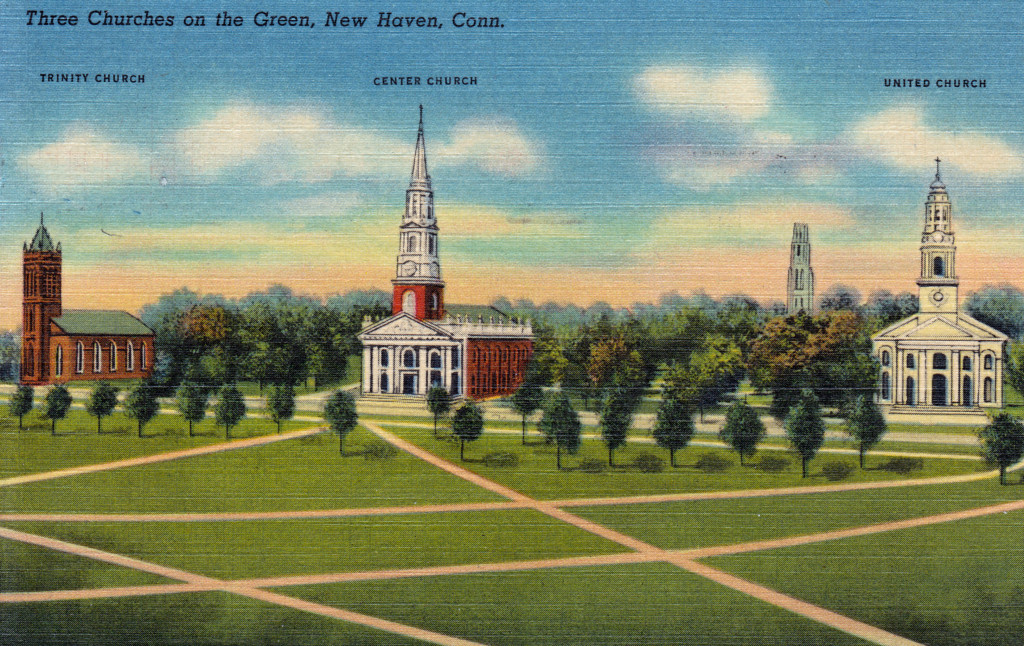
Now, while the Yale Nantucket-Vineyard crowd wanted some wiry, tangled guinea snatch as a chaser for their usual blonde, silken delights, Wooster Square girls wanted husbands. Tired of wife-beaters, garlic, and goomba parading, they wanted the real America, the white, flaxen-haired, well-tailored and well-mannered men of Yale.
So it was easy pickin's for Yale men, so it was within that augury that Arthur's roommates disabused him of his 'love' for this non sequitur, inconsequential woman.
It worked, and Arthur straightened out, went up to Smith, Vassar, and Wellesley, dated the most eligible girls from his milieu and married well. A home on Park Avenue, winters in the islands, and of course summers on Nantucket.
Yet, for reasons neither his family, colleagues, or friends could understand, Arthur still had that itch for something other than the flaxen-haired beauties of his class, and took up with Annie Casertano from the Brooklyn projects. She was a single mother with two children, surviving on welfare and downtown Manhattan cleaning jobs, divorced twice, both from Italian dockworkers, but for some inexplicable reason was Venus de Milo for Arthur Townsend. He wasn't sure which he loved more - Annie or the projects, such was his nostalgie de la boue and ornery populism.
Managing the affair was tricky. He and his family lived in Greenwich and the hours of his Wall Street job were punishingly long, so sojourns in Bay Ridge were not easy. Yet, he managed. He had too such was his extraordinary desire. Although the nasty remarks of his Yale roommates often popped up on the Far Rockaway train to Brooklyn, clattering around and interrupting his thoughts of the beautiful Annie, but he dismissed them.
She hoped that he would leave his wife but she had no clue about his other life, the rarified atmosphere of the well-to-do, or the near impossibility of him marrying below one's station, so assumed that love would conquer all and her ships would come in.
As for him, an affair in Bay Ridge was far easier to conceal than one in the city - his stories about layered loans, redevelopment projects, and offshore money were easier for his wife to take on face value than if he simply was 'staying late at the office', or meeting clients in Gramercy Park.
Perhaps it was the contrast that did it - dark, hippy, high-heeled, made-up Annie from the projects and elegantly tailored, manicured, Armani and Arpege Elizabeth Barrett Browning from Beacon Hill. Coming home after a Saturday with Annie - driving up the long driveway past the carriage house and the stables, admiring the thousand-year old oak tree, being greeted by Samuel the butler and kissed by his fragrant, wine-scented wife was immeasurable. From one set of arms and bed into another, irreplaceable.
Just to be clear, the projects in Arthur's day were nothing like they are now - savage, tribal places ruled by gangs, hookers in the halls, Fentanyl dopers sagging and frozen on the steps, pimps and tarts on the avenues. They were just poor white, just like New Brighton across the tracks but more concentrated. The smell of garlic and roast peppers was in the halls, in the elevators, and on the stairs. Arthur could have been visiting Marilyn Petrucci on Alexander Street and instead was on the 21st floor of the Verrazano Homes.

Annie never gave up hope, and so the goomba idyll so fantasized by Arthur Townsend continued. A black-white thing in these same projects renamed the Frederick Douglass Homes would never be possible in a million years, but today class has been replaced by race and the barriers are impenetrable. Slumming - for that was what his wife called it when she finally found out where he was punching his ticket - does not exist today.
Elizabeth forgave him, he gave up the life and they lived happily ever after, but lounging on the beach on St. Bart's he was sorry that class had disappeared. He liked being upper upper in bed with lower lower and smelling pasta fazool on the stove. No one of the new technocratic empire would ever know the pleasure. Oh, sure, there was always Louise from Gaithersburg but she was just anybody, and there was nobody like deep guinea Annie Casertano or Marilyn Petrucci anymore.


 Posts
Posts


No comments:
Post a Comment
Note: Only a member of this blog may post a comment.