"Whenever I go into a restaurant, I order both a chicken and an egg to see which comes first"

Saturday, April 23, 2011

Doing Good and Living Well: Hotels II (and Food)


One of my favorite hotels was the Mille Collines in Kigali.  It was set high on one of the city’s many hills, had commanding views over the surrounding valley and the mountains beyond.  There was an Olympic-size pool, and at night, the hotel backlit the façade with a variety of pastel lights.  I loved lying on a chaise longue, looking out over the lights of the valley or up to the trellised rooftop restaurant; and I never wanted to be any other place but there.

The hotel had an active local bar, a spacious lobby with tropical planters, brass railings, and a polished floor.  Best of all, it had a massage parlor on the way from the lobby to the pool.  The massages there were cheap ($8.00/hr.) and the best I ever had.  There were three young women working there, and I never had to choose among them.  Each one had long, graceful but strong fingers, which worked every muscle from toe to scalp with just the right pressure.  The massage was always more like a long caress. 

Every time I walked to the bar by the pool, I was tempted to get a massage.  During a long stay I always upped the number of times I went from twice a week, to three, and then to four.  I certainly could have gone all seven days, but there was always some Puritanical barrier which I couldn’t cross.  Whenever my shoulder dipped towards the young ladies waiting by the doorway, beckoning, the cold,damp chill of the Scottish Highlands came over me, and I continued on to the pool.

Oyster and sushi bars have that same gravitational pull.  I often walk past two restaurants on M Street in Georgetown, where the oysters are piled high against the windows, and I can see the shucker, and the sweet, juicy oysters lined on iced trays.  The temptation is almost impossible to resist.  I spend hundreds of dollars a month on oysters, so it isn’t exactly like the $8.00 rubs at the Mille Collines, and I was able to resist, but never easily. 

Sushi has always had the same effect.  The first time I ever had sushi was in Narita, Japan in 1980.  I was returning from a World Bank mission to Indonesia, and was booked to stay at the airport hotel which was not at the airport proper, but in the town.  After watching some Japanese baseball on TV, I took a bus into the old part of town.  Narita at that time was still an old, traditional town, and was really more of a village.  It was the home to one of the most important Shinto and Buddhist shrines in the country, and Japanese tourists could get a religious two-for-one by visiting there. 

The shrines were stunning in their simplicity – in a wooded setting with pines and cypress, flowered walks leading to small shrines with stone statues, or to rock and sand gardens; or finally to one of the old wooden Shinto shrines.  I couldn’t believe my luck.  I had not read about this, nor planned it in any way.  It was simply a gift, more welcome and appreciated because it was so unexpected. 

I walked back to the town center to get my shuttle bus back to the hotel and passed a restaurant with pictures of the food posted in the windows.  There were perhaps twenty pictures of sushi.  Everything was in Japanese, but the pictures were enticing.  Maybe it was my passion for raw oysters which began in the early 70s in Paris which gave me some predilection for raw fish, or maybe the pictures looked good, or maybe I was just hungry, but I went in.  After the first bite of buttery fatty tuna, I was hooked.  I went on to eat everything they offered – uni, unagi, toro, ikura, and much more; and I only stopped because I thought I should.

When I got back to Washington I looked up and found a Japanese restaurant near the Bank, and went there for sushi.  After the sushi chefs got to know me, I stopped ordering, and they prepared one delectable morsel after another.  Sushi, sashimi and entremets of sculptural reeds and leaves, bits of salty or pickled morsels, then more fish.  I couldn’t stop, but did only because I was spending over $100 a meal – and this in 1980.

Later on, I discovered Makoto, a Japanese restaurant in the Palisades, and at the time it was a real Japanese place.  Excellent sushi, and a 10 course dinner where each course was an architectural creation and sumptuous portions of raw and cooked fish.  It declined quickly in quality as it got more popular.  The fish gradually disappeared and the dinner was mostly vegetarian, and the only Japanese accent to the place was getting yelled at as you entered and left.

One day for lunch I was at the sushi bar, and kept ordering more and more delicacies, trying new ones and going back to the ones I especially loved, mixing the rich custardy sea urchin with the salty salmon roe, balancing both with grilled mackerel and eel, going back to the beginning for more tuna and yellowtail.  After a third round, the sushi chef turned to me and asked, “Don’t you think you have had enough?”.  Obviously I had crossed the line beyond the grotesque intemperate Gorgon caricature of an American and the counter guy just had to say something.

In any case, the Mille Collines was a great hotel, and there were many good restaurants nearby, many open-air because the climate was cool and fresh and mosquitoes were never a huge problem.  My favorite was a pizza place, but this was no Papa John’s.  They had a wood-burning stove, the crusts were thin and crispy, and the toppings made from fresh tomato, four kinds of imported cheese, and homemade sausage.  The food was superb, and the view from the patio over the many hills and lights of the city was spectacular.

I always stayed in the same room at the Mille Collines because it took me so long to find; so I should say that it is a great hotel if you get the right room.  For my first stay they offered me “A quiet room on the top floor, with a great view of the hills”.  It was all the above, except that it was right below the terrace restaurant, and every night around 7pm the scraping, grinding, and banging of the heavy wood chairs on the terrace floor sounded like Patton’s army on the move.  I tried to convince myself that I could live with it.  It was a great room, and changing is always a pain.  When the auto-psyching didn’t work, I tried ear plugs, wrapping my head with pillows, and turning on the radio to a music station.  Nothing worked.  Although the rumbling of the tanks was muted, they were still there.

“We can give you a similar room on the third floor”, the concierge told me. “Very peaceful, and no terrace restaurant”.  Again, all the above was correct, except for the fact that the floor had recently been converted from a smoking floor, and despite their best efforts, it still stank like a cheap trucker’s joint off the Interstate.  I was later told by a friend in the business that nicotine has a kind of half-life – it breaks down slowly, and unless you power- and steam-clean all possible nooks and crannies of the duct works, it will still smell like stale cigarettes.

“The second floor rooms are equally fine”, I was told the next morning, “although without the view”.  Correct, but also the traffic noise, a distant hum from the upper floors, was a persistent roar down below.  That, and the floor was right on top of the poolside restaurant, so the liveliness that I enjoyed while at the bar, was unwelcome at bedtime.  Finally I found the one room which was perfect – in a quiet corner of an annex, great view of the pool, nothing on top, nothing below. 

Another favorite hotel was in San Salvador (it changed owners many times from Hilton to Radisson, etc.) for many of the same reasons that I liked the Mille Collines – it was breezy and open, and since it was high up and at the base of the volcano, always cool and fresh.  The lobby had a finely polished black marble floor, great brass urns of tropical flowers, an active bar overlooking the pool, the gardens, and the volcano beyond, and a Cuban cigar store.  I love cigars, and Cuban puros are all they are said to be.  Rich, flavorful, no bite, and a gentle, easy draw.  I bought one of these delicious cigars every day, sat in the breezy lobby, watching the comings and goings of le tout San Salvador, the fading evening light, and knew that I wanted to be no place else in the world.

San Salvador was then, as it is now, a dangerous place, so my excursions were limited; but there was a great tipica place within a 100’ of the hotel.  Delicious sopa de mondongo – basically a chicken soup with all of the innards (gizzards, liver, hearts), a piece of corn on the cob, and fresh vegetables, all accompanied by fresh tortillas, made from fragrant yellow corn, and almost like corn muffins.  A cold beer and I was in heaven.

MORE TO COME…..

Recipes - Italian Pastas

My mother was a very good cook – modest by today’s foodie standards, but still good.  Despite her desire, as a first generation Italian American, to get the garlic smell out of her house, she gave in to my father on occasion, and we had Neapolitan food.  All of the memorable dishes were from Christmas eve – Southern Italian tradition was to have sette pesce – seven different kinds of fish, and while we never ate that many, at least had anchovies, squid, and eel.  The anchovies were for a pasta sauce, the eels were cooked in a deep, rich tomato sauce, and the squids were either cooked in the same tomato sauce, but with lots of hot pepper, or stuffed with breadcrumbs, oregano, parsley, and garlic – again in spicy tomato sauce.

My father loved an “all-day” tomato sauce with three kinds of meat – veal, pork, and beef – which were simmered for hours.  The result was a thick, intensely flavorful sauce, and tender meat.

The all-day sauce prepared by my grandmother had bulbs of garlic – or so it seemed -, cups of extra virgin olive oil she brought from New Haven (extra virgin, unrefined oil unlike my mother's tasteless Filippo Berio Extra Refined Olive Oil), and a great fatty hunk of pork shoulder.  Shovelfuls of oregano and basil of course, chianti, and some hot pepper flakes.  We couldn’t believe how good it was. 

Inspired by my grandmother, here are some recipes for my pasta sauces: 

All-day Sauce

Image result for images all day neapolitan tomato sauce

This does not have to cook all day, but simmer for about 3 hours.  The extra time is worth it. 
* 1 large can San Marzano tomatoes, preferably low sodium.  There are some good brands now available at Whole Foods
* 1/2 can tomato paste, preferably low sodium.  I like to add my own salt where I have more control
* 1 cup red wine.  This can be inexpensive wine.
* 1 large handful fresh basil, chopped; and 1 Tbsp. dry basil
* 5-6 lg. cloves of garlic, coarsely chopped
* 2 tsps. sugar
* 5-6 Tbsp. olive oil (I think that’s the amount.  I don’t ever measure; but be generous, and it should cover the bottom of a large pot with more than a thin covering.) 
* 5-6 shakes hot pepper flakes
* 1 1/2 lbs. pork shoulder, bone in (or bone out, not too much difference)
* Salt and ground pepper to taste
- Sautee the garlic and spices in olive oil for about 5 minutes, careful not to brown or burn the garlic

- Add the tomatoes, tomato paste, sugar, and wine.  Cut up the tomatoes with a knife or sharp cake knife so that they will cook more evenly.  Stir well

- Add the pork

- Lower heat, and simmer for about 3-4 hours until pork falls off the bone, sauce has been reduced to be thick and not watery.  Stir every hour or so.

- Serve over spaghetti or spaghettini (recipe is for 1/2 lb. of pasta, more or less.  Same for all recipes to follow)

Spaghetti with Anchovy Sauce

Image result for images neapolitan spaghetti with anchovy sauce

Even people who say they don’t like anchovies will like this sauce.  The anchovies blend perfectly with the white wine, lemon, and garlic to give a spicy, fragrant, light pasta dish.  It takes no more than ten minutes to make!
* 1 can flat anchovies
* 5-6 Tbsp. olive oil (as in the above recipe, enough to liberally cover the bottom of the frying pan.
* 5-6 large cloves of garlic, coarsely chopped
* Juice of one lemon
* 5 liberal shakes of hot pepper flakes
* Large bunch of parsley, coarsely chopped
* 5 grindings black pepper
* 1 1/2 cups white wine (ordinary wine will do, but not chardonnay, which is too strong)
- Sautee the garlic and anchovies in the olive oil, mashing them both as you sautee.  Cook only until they are mashed, and no more.  Additional cooking gives a very strong fishy taste which you want to avoid at all costs.

- Add the hot pepper flakes and stir for a few seconds
- Add the wine and parsley, ground pepper, and stir well.

- Simmer for about 5 minutes until the alcohol has evaporated (taste to see – there will be no bitter alcohol taste), and turn off the heat.

- Add the lemon juice

- Serve over capellini, angel hair, or spaghettini.  The classic is with capellini or angel hair, for these really catch the sauce.

- Plate and garnish with chopped parsely

Spaghettini  al Olio, Alio, e Peperoncino (Olive oil, garlic, hot pepper)

Image result for images neapolitan spaghetti al olio, aglio, e peperoncino

This is THE simple Italian pasta dish.  Minutes to prepare, and wonderful.  When prepared properly (the garlic has to be lightly browned – more and it gives a bitter taste; less and it has none of the sweetness brought out by the browning), it is the sweetest, most flavorful dish….surprising because of the few ingredients.
* 5-6 Tbsp. olive oil (again, should liberally cover the bottom of the pan
* 6-7 lg. garlic cloves, cut into thin slices (not transparent thin)
* 5-6 liberal shakes hot pepper
* ground fresh black pepper
- Sautee the garlic in the olive oil, being very careful to get it golden brown and no more.  Remember that the oil will stay very hot for a few minutes after you turn off the flame, so you have to anticipate the browning process…which is why this recipe is simple, but then again not so simple.

- Serve over 1/2 lb. spaghettini

Pasta with fresh basil

Image result for images bunch fresh basil

This is perhaps THE SIMPLEST pasta dish, with none of the careful watching required in the one above.  You will be surprised to see how these few ingredients with no real preparation blend into an incredibly tasty dish.  I learned it from a friend in Paris in the early 70s.  When he proposed it, I immediately vetoed the idea.  “Are you kidding?”, I said. “Hey, we’re in Paris, surrounded by the best ingredients in the world”.
“Trust me”, he said; and it turned out to be one of my favorites today.
* 3 lg. cloves of garlic, crushed (with a flat knife to release the oils)
* 4-5 Tbsp. olive oil
* 1 large handful fresh basil leaves (clean the leaves from the stems and use only the leaves.  More is better)
* 1/4 cup freshly ground parmesan cheese
* ground pepper
* 1/2 lb. spaghetti
- Place a bowl on a warming tray, and in it put the oil, garlic, and basil leaves and toss

- Let stand for about ten minutes while you are cooking the pasta.

- Toss the pasta into the warmed basil mixture, plate, sprinkle with parmesan and ground pepper

Spaghetti Marinara

Image result for images pasta marinara with clams

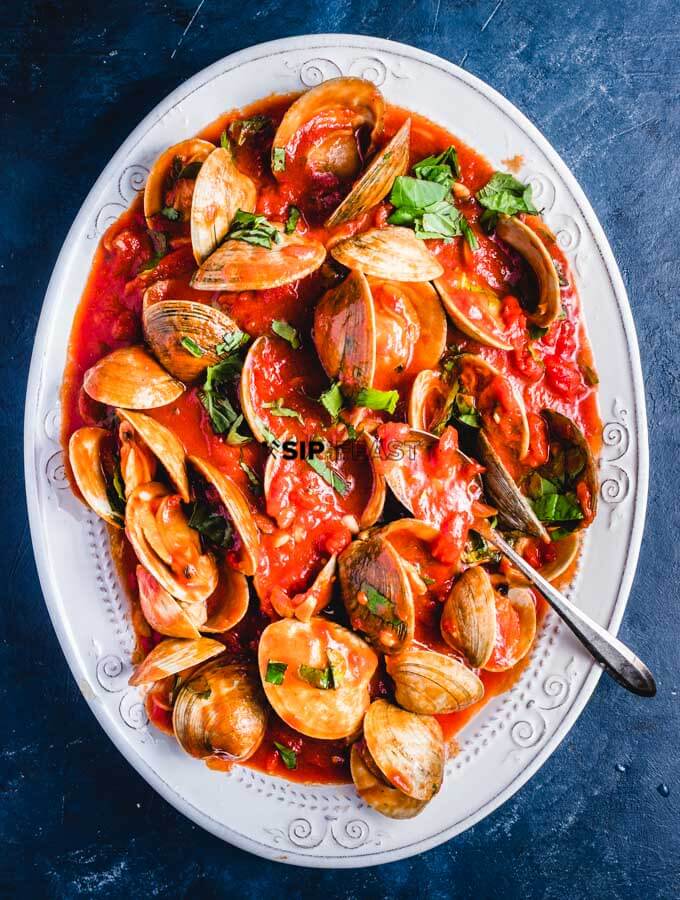
Spaghetti marinara in America has come to mean a simple meatless tomato sauce; but in Italy it is with sea food (marinara = from the sea).  It is a super dish, not hard to prepare, but takes a bit more time than the above recipes.  In my mind it is well worth it, for it has an intense seafood taste (i.e. from the squid, shrimp used to flavor the sauce) and the variety of seafood served on top is exciting.
* 1 lg. can San Marzano Italian tomatoes
* 1/2 can tomato paste
* 1 cup red wine
* 1/2 lb. cleaned squid, cut into 1” pieces (use both tube bodies and tentacles)
* 1/4 cup olive oil (should be about 5-6 Tbsp.)
* 5-6 lg. cloves of garlic, coarsely chopped
* handful of fresh basil, chopped
* 2 tsp. dried basil
* 2 tsp. sugar
* 12 pasta neck or littleneck clams
* 1/2 lb bay scallops
* 12 large shrimp, steamed and peeled
- Sautee the garlic, basil, and hot pepper flakes for 2-3 minutes

- Add squid, and sautee for another 5 minutes

- Add tomatoes, tomato paste, sugar, and wine, and stir

- Simmer for about three hours, stirring every hour, adjusting salt (also spices)

- Steam and peel the shrimp, set aside

- Just before serving, steam the clams, reserve, and cook the bay scallops in the steaming liquid for 2-3 minutes.  DO NOT OVERCOOK

- Plate the pasta, cover with sauce, and divide equally the clams, shrimp, and scallops on each plate

- Garnish with chopped fresh parsley and ground pepper and serve.

Friday, April 22, 2011

Ron’s Recipes, Tuscany, and the Great Brasseries of Paris


A few years ago, my daughter gave me one of the best birthday gifts I have ever received – a blank book.  She said in the inscription: “This book is for recording your tasty recipes and special creations.  Maybe one day you’ll write a Parlato cookbook…”

The blank book is almost filled, so I thought I would start transcribing them, and giving some thoughts about each one.  I will do 4-5 per posting.  An important NOTE – these recipes are for people who know a bit about cooking.  The proportions are approximate, and in all cases, feel free to add or subtract.  My idea in the recipes is to give you the idea of a dish and the ingredients that go in it.  I have tried to be as accurate as possible on the amount of ingredients, but don’t slavishly follow the directions.

There are over 100 recipes; so I will simply begin at the beginning, noting those that are my particular favorites.

Papardelle with Sausage, Mushrooms, and Rosemary

The combination of Italian sausage, mushrooms, and rosemary is a classic.  It is Tuscan in inspiration, but the rosemary is Mediterranean.  The papardelle (very thick ribbon pasta) is perfect with the meat sauce.  Tuscan cooking is heavier than Mediterranean, lots of meat and beans…and all served with unsalted, crunchy crust whole wheat Tuscan bread.  Pasta fagioli  or pasta with beans (in Napolitan dialect “pasta fazool” ) is a delicious blend of garlic, celery, bacon, and canneloni beans; and I have always thought close to Tuscan meals.  This recipe, without beans, is delicious:

* Italian sausage (3 links)

* 2-3 cups porcini mushrooms (any dark mushrooms will do), cut in half

* 1/2 cup sherry (Amontillado is best – not too dry, not too sweet)

* 1-2 Tbsp. dried rosemary, crumbled lightly

* 1 Tbsp. extra virgin olive oil

* 1/2 cup freshly grated Italian parmesan cheese

* freshly-ground pepper and salt

* 1/2 lb. papardelle

- Sautee sausage in the olive oil , remove, and cut into 1” pieces, reserve.

- In the same frying pan, add the rosemary and mushrooms; sautee over high heat until the mushrooms start to get soft.  Add the sherry, keep at high heat, and cook until the mushrooms are done (there should be no liquid at the bottom of the frying pan).  Taste near the end of the cooking to adjust for more rosemary, sherry.  Add salt and freshly ground pepper

- Combine the sausage and the mushrooms and let simmer for about 10 minutes to blend the flavors.

- Boil the papardelle to al dente

- Plate the papardelle and add the sausage/mushroom mix; sprinkle with parmesan cheese.  Serve

Papardelle with Four Kinds of Mushrooms

This is a wonderful variation of the above recipe.  The difference is that you use four kinds of mushrooms rather than one, you leave out the rosemary, and you add cream.  The cream makes all the difference,and gives the sauce a particular richness and a bit of a French touch. You can use your imagination with the mushrooms.  I have suggested shiitake as one of the mushrooms because of its particularly earthy flavor; and I recommend a dried Chinese mushroom because these have a very intense mushroom flavor.  You can add others as well.  The Dupont Circle Market on Sundays in the summer has an impressive array of mushrooms, and  I am sure most Farmers Markets do as well.  You want to choose the woodier, darker, more flavorful mushrooms for this dish.

* 4 kinds of mushrooms (porcini, chanterelle, oyster, shiitake etc., as above), cut in half

* 1 dried Chinese mushroom, hydrated, chopped

* 1 Tbsp. butter

* 1 Tbsp. olive oil

* 3 Italian sausage

* 1/2 cup sherry

* 1 cup of half-and-half

* 1 cup grated Italian parmesan

* 1/2 lb. papardelle

Same directions as above; except once the sausages and mushrooms are well combined, add the cream, stir until the mixture gets to a nice brownish hue, season with salt and pepper, serve over papardelle, sprinkle with parmesan and add a few grindings of pepper.

Crab Cakes

I am told these are the best crab cakes anyone has ever eaten, and I am not sure what the secret is, except lots of crab, and a few non-traditional ingredients like flatbreads and red pepper. 

* 1 can/container crab meat.  I used to buy the pasteurized variety from Indonesia,Thailand and available from local supermarkets like Superfresh or Giant.  While this is very good, it is nothing like the fresh crab available from Whole Foods or Farmers Markets.

* 2 medium eggs, beaten

* 1/2 red pepper diced

* bunch parsley , moderately chopped

* 1/2 red onion, moderately chopped

* 1 lg. Tbsp. Mayo (I prefer Hellman’s to the more foodie types with lots of olive oil)

* 1 lg. Tsp. Maille mustard (or other spice French mustard)

* 5 liberal shakes Bay Spice

* freshly ground black pepper

* 5 liberal shakes Tabasco

* 3 “Everything” flatbreads (should have lots of seeds), crushed moderately in blender

* 1 English muffin or other white bread, also crushed in blender.  The bread crumbs should not be very fine

* 1 tsp. baking powder

* 2 Tbsp. flour

* 2 Tbsp. unsalted European style butter

-  Put all ingredients into a large mixing bowl and mix well

-  Let sit in refrigerator for 3-4 hours

- Make 2-3” patties (cakes) and place on waxed paper on dish; sprinkle lightly with flour on one side

- Heat the butter in a cast iron skillet on high heat until almost brown; add crab cakes, side down with the flour; cook for about 5 minutes or until brown

- Flour the other side while in the skillet; and flip when first side is brown; cook over high heat until brown

- Turn down heat to medium, and cook for about 10 minutes or until done.  The crab cakes should be moist inside – not runny or well done, but moist.  This is a key to a good crab cake.

SERVE

Alsatian Sauerkraut

This is a variation of the classic Paris brasserie choucroute.  The Parisian version is served with ham, smoked pork, and sausage, and is marvelous. When Peggy and I were in Paris for her two month sabbatical a few years ago, we ate in all the great brasseries.  Let me digress a bit, and list of some of the best:

* Brasserie du Terminus du Nord – this place is right across from the Gare du Nord in a slightly sketchy area of Paris serving the northern suburbs, the scene of a lot of the racial violence in the past.  This should not put you off however, because the Metro goes right to the Gare, and the restaurant is across the street.  It is a classic brasserie – Victorian décor, tuxedoed waiters with white towels over their arms, white tablecloths, proper silver.  My favorites in all these places are oysters, briny Fines de Claires and Belons; but the filet of sole, the cold seafood platter (heaped with oysters, mussels, shrimp, araignees de mer, and more), the tourteau (a kind of Dungeness crab), the sauteed liver, and the steak are perfect.  And of course, the Choucroute Alsatienne.

* Brasserie Flo – this restaurant is up towards the periphery of Paris, and to get there you have to walk along the chemin des putains, and the garment district.  A real landmark, and well worth the trip.  Brasserie Julien is similar, but not in such a cool area.

* Le Boeuf Couronne -  You go there for meat, and it is much simpler in design without the Victorian glitz, but the oysters and the meat are superb.  You can combine it with a walk along the Canal St. Martin which is one of the new hipster areas of the city.

La Coupole – this brasserie in Montparnasse used to be THE place to go in the 70s after midnight (and may still be, but now past my bedtime).  The scene was incomparable – a cross between the Bois de Boulogne transvestite scene, the Castro, Andy Warhol.  Everything went down there, everybody was looking for something and usually found it. It is old Victorian and actually has a grand cupola.  After many years going there after midnight, I happened to go there with my sister and very Republican brother-in-law and children for lunch, entirely different scene entirely.  We were with my very Francophile sister-in-law, resident advisor to what one must do and see in Paris.  The brother-in-law ordered curry; and the sister-in-law uttered the now famous and oft-repeated: “Oh, no-no-no-no-NO.  You don’t want to order that”; and the stubborn very American Malcolm of course did eat curry while we winced.

* Le Dome – right next to La Coupole, but very, very different.  I had the best meal ever at Le Dome.  We sat in a glass-enclosed section of the restaurant, right on the sidewalk, bright and sunny, had an exquisite Pouligny-Montrachet grand cru (I can remember the delicate fragrance after seven years as if it were yesterday), and three or four courses of fish and fowl (I think I had game hen). 

* Bofinger, Wepler – these are the over-the-top brasseries where you will for sure get great food, but you go there for the Baroque décor

* Lutetia, Petit Lutetia – both of these brasseries are close to each other, one in the 6th and the other in the 7th.  The Petit Lutetia was my hangout, because it was at the top of the street where we were staying.  It was not done in the grand style (nor the Lutetia, which was famous for housing Nazis during the war).  In both you get the standard brasserie fare – liver, brains, steak frites, oysters, sweetbreads, etc., and I love offal!

* Vagenende – a very unpretentious hangout for the locals of the Latin Quarter.  Wonderful food.

OK, here is my choucroute alsatienne recipe without the big meat:

* 1 lg. head of cabbage, dense (some heads of cabbage are lighter, and so tightly packed), chopped coarsely

* l Vegan bouillon cube (any salt-free vegan or chicken will do)

* 2 cups water

* 1/2 bottle Sauvignon Blanc, Sancerre, Pinot Grigio

* 2-3 cups gin

* 2 Tbsp. carroway seeds, lightly pounded in a mortar

* 1/8 lb. bacon whole

* 3-4 bay leaves

* 10 coriander seeds

* 10 peppercorns

* 1 lg. onion, chopped coarsely

* 4 medium carrots, peeled, chopped into 2” pieces

* 4 Tbsp. olive oil

-  Pour water, wine, olive oil, and gin into large pot; add spices; bring to a boil.  Throw in cabbage, onion, carrots.

-  Let simmer for about 1 1/2 hrs. covered and 1/2 hr. covered until there is a scant 1/2 inch liquid on the bottom of the pan.

-  Taste for salt, pepper.  SERVE

If you want to serve with meat, serve with ham and sausage (weisswurst is best) that have been boiled.

Pasta with Porchetta pieces and fresh tomatoes

We spent five glorious 5-week  family vacations in Tuscany.  My children say that whenever they want to relax before going to sleep, they run the tape of the Tuscany vacations – the 400 year old farmhouse in the middle of sunflower fields, breakfasts under the cypress with big bowls of coffee and Tuscan bread with local butter and jam; walks through the Medieval and Renaissance towns close by, and buying the ingredients for a civilized lunch; swims at Lake Trasimeno and drinks under the shade trees watching the vaporettos dock.  It was wonderful.

One of the most special occasions was going for porchetta at the local butchers on Sunday.  The whole suckling pig was roasted all night; and in the early morning carved and served.  My son and I arrived the very first, and the butcher always gave my son the tasty prized morsels – bits of liver, head parts, and snout all in a spicy oregano, thyme, etc. paste.  Ahhh….We ate the luscious slices of roast pork for lunch with good Tuscan bread.

For dinner, I made farfalle with porchetta bits and fresh tomatoes:

* Remainders of the porchetta – bits of whatever was left over, and all the scraps of spices and fat

* Fresh summer tomatoes, chopped

* Handfuls of fresh basil, chopped

* Olive oild

* Salt and pepper

I sauteed the porchetta bits in olive oil until they were very lightly browned.  I added the tomatoes and basil and simmered for about an hour.  Served over farfalle, sprinkled with fresh grated parmesan.

For the porchetta bits, I would substitute roast pork leftovers, especially the salty, seasoned bits by the bone. 

MORE TO COME…..