"Whenever I go into a restaurant, I order both a chicken and an egg to see which comes first"

Tuesday, September 15, 2026

Jealousy - The Evolutionary Advantage Of Sexual Suspicion

There is no more common human trait than jealousy.  Shakespeare understood it perhaps better than most, and featured virulently jealous characters in Othello, The Winter’s Tale, Cymbeline, and Much Ado About Nothing.  While these are plays about men behaving badly – all have been duped, tricked, and deceived, and on the flimsiest of evidence have gone on to condemn their lovers and by the way condemning all women.  Othello tells his judges about to sentence him for the murder of Desdemona that he did them a favor ridding the city of yet one more lying slattern.

Image result for images othello

Claudio, lover of Hero, is taken in by the most transparent trickery of Don John who wants to avenge Claudio’s military victory.  He arranges for a mock balcony scene where imposters play Hero and her lover and their exchange is to be overheard and relayed to Claudio.  Claudio takes this contrived hearsay for fact, and launches a virulent attack on the unfaithful Hero and on all women.  Even Leonato, Hero’s father is quick to judgment and assuming guilt condemns his daughter.

Posthumus in Cymbeline is taken in by Iachimo, and in one of Shakespeare’s most violently misogynistic passages, condemns his wife as a treacherous vixen.  The men, fathers and sons, in The Winter’s Tale are no different. Hearsay added to innuendo and jealous suspicion throws the sweet, innocent Perdita’s character into disrepute.

As much as one can accuse the men of these stories of hateful misogyny, jealousy is standard fare for all societies. A woman’s infidelity, never certain and always suspect, can lead to illegitimate birth, questions of lineage and heritage for the well-to-do and questions of economics for the hoi polloi. Why should a man, hard pressed to survive in a marginal environment, invest anything in a child who is not his? Issues of misogyny, machismo, patriarchy, and sexual abuse all derive from male uncertainty. It is a matter of security, let alone male ego and pride, to know paternity.

Charles Darwin - Theory, Book & Quotes - Biography

As much as one can accuse the men of these stories of hateful misogyny, jealousy is standard fare for all societies. A woman’s infidelity, never certain and always suspect, can lead to illegitimate birth, questions of lineage and heritage for the well-to-do and questions of economics for the hoi polloi. Why should a man, hard pressed to survive in a marginal environment, invest anything in a child who is not his? Issues of misogyny, machismo, patriarchy, and sexual abuse all derive from male uncertainty. It is a matter of security, let alone male ego and pride, to know paternity.

Some bio-ethicists such as Megan Doe have suggested that jealousy provided an evolutionary adaptation for males to assure paternity and to avoid spending resources on other males’ offspring and led females to guarantee protection and support for her offspring by having a steady partner. Men need to be sure that their children are theirs; and women, once having secured an economically viable mate, need to be sure that he doesn’t stray.

Critic Gail Kern Paster focuses less on evolutionary factors for jealousy and suspicions, and draws on Pauline influence: “Sixteenth century English society had not yet dispensed with forms of overt, virulent misogyny inherited from medieval Catholicism which made marriage, especially for men, a less perfect way of life than celibacy.”

She goes on:

The point is not only that the difference between man and woman…but that women are responsible for their sins, and men are not. Even more crucial is to recognize the instability between a misogyny which posits All-Women-Are-The-Same and an idealization which posits Women-as-Different. In the conversations between Claudio and Benedick, as in the similar conversations between Romeo and Mercutio this instability in the categorization of women is easy to detect. “Can the world buy such a jewel as Hero?” idealist Claudio asks rhetorically. “Yea”, comes the misogynist’s bawdy reply, “ and a case (vagina) to put it into”.

Image result for images much ado about nothing

Perhaps the best fictional depiction of jealousy is in Strindberg’s play, The Father.  For years the Captain has ruled his wife, Laura, and commanded all decisions about her, their home, and their daughter.  When Laura feels that he has finally overstepped his bounds, making arbitrary decisions about their daughter and her education, she decides to refuse and force his capitulation.  She does so with the psychological canniness and evil intent of Iago, introducing the idea, however subtlety that their daughter is not his. She knows that paternity is at the heart of male jealousy and insecurity – men can never absolutely know whether the children borne by their wives are theirs – and she progressively suggests that their child might not be his.  Such doubts, especially since they never can be proven, are by nature corrosive, and eventually the Captain goes mad.  Laura commits him to a mental institution, and she takes charge of her daughter.  Adding insult to injury she tells him, “Now you have fulfilled your function as an unfortunately necessary father…, you are not needed any longer and you must go.”

Marcel Proust was perhaps the most eloquent about jealousy:

It is not even necessary for that person to have attracted us, up till then, more than or even as much as others. All that was needed was that our predilection should become exclusive. And that condition is fulfilled when – in this moment of deprivation – the quest for the pleasures we enjoyed in his or her company is suddenly replaced by an anxious, torturing need, whose object is the person alone, an absurd, irrational need which the laws of this world make it impossible to satisfy and difficult to assuage – the insensate agonizing need to possess exclusively.

Vladimir Nabokov was equally compelling about jealousy, and in the final scenes of Lolita Humbert has Claire Quilty read this poem:

Because you stole her
from her wax-browed and dignified protector
spitting into his heavy-lidded eye
ripping his flavid toga and at dawn
leaving the hog to roll upon his new discomfort
the awfulness of love and violets
remorse despair while you
took a dull doll to pieces
and threw its head away
because of all you did
because of all I did not
you have to die

Image result for images clare quilty scene movie lolita frank langella

And Milan Kundera in The Unbearable Lightness of Being

Before long, unfortunately, she began to be jealous herself, and Tomas saw her jealousy not as a Nobel Prize, but as a burden, a burden she would be saddled with until not long before his death.

Shakespeare’s Sonnets to his young man express a jealousy which is romantic and purely felt.  The poet expresses no anger, no hostility, or no vengeful thoughts. It is simply love which demands an emotional fidelity to be returned and requited:

Sin of self love possesseth all mine eye/And all my soul, and all my every part;/And for this sin there is no remedy/It is so grounded in my heart…(Sonnet 62)

While Darwin’s Origin of the Species makes ultimate sense and has been part of the scientific canon for over 150 years, it is hard for many to accept its application to human behavior.  Yet, there it is, the survival of the human species characterized by territorialism, self-interest, aggressive defensiveness, tribal hegemony, and the impulse to dominance.  That we are no different from the animals is one thing, but to accept the fact that we can never outgrow, evolve or mature from a hardwired human nature is another entirely.  Despite millennia of human history and its record of territorial wars, the bloody expansion of empire, and the perennial struggles for supremacy, there are those who insist that we can overcome this nature and become better human beings.  We can achieve Utopia, a peaceful, verdant, calm and collaborative world.

These same observers would like to think that the personal drives and instincts that fuel the international conflicts of today and yesterday can be blunted, expunged, and dismissed.  Jealousy, known less for its literary appeal and universality and more for its physical violence, abuse of women, and virulent misogyny is no different.  With compassion, understanding, and education, men can be tamed of their worst instincts.

The evidence is all to the contrary, and jealousy is an essential piece of our Darwinian destiny.  Jealousy is an expression of possession, and possession is at the heart of survival of the fittest.  Men are jealous of the women they have won because of their high valuation of them, and the chance to continue the line.  Women are similarly jealous of the men they have attracted because they do not want to lose their prized possessions.

Jealousy is here to stay and well it should.

Monday, September 14, 2026

Class, Culture, And Sex - The Saga Of A Yale Man Who Ventured Across The Tracks At His Peril

Town-Gown relationships at Yale were always testy back in the day when East was East and West was West; or in other words, venture across the tracks at your own peril.  Maria and Leona might be appealing - a break from the blonde, blue-eyed, predictably suitable women from Smith, Holyoke, and Vassar that one was expected to marry - but they were dangerous.  

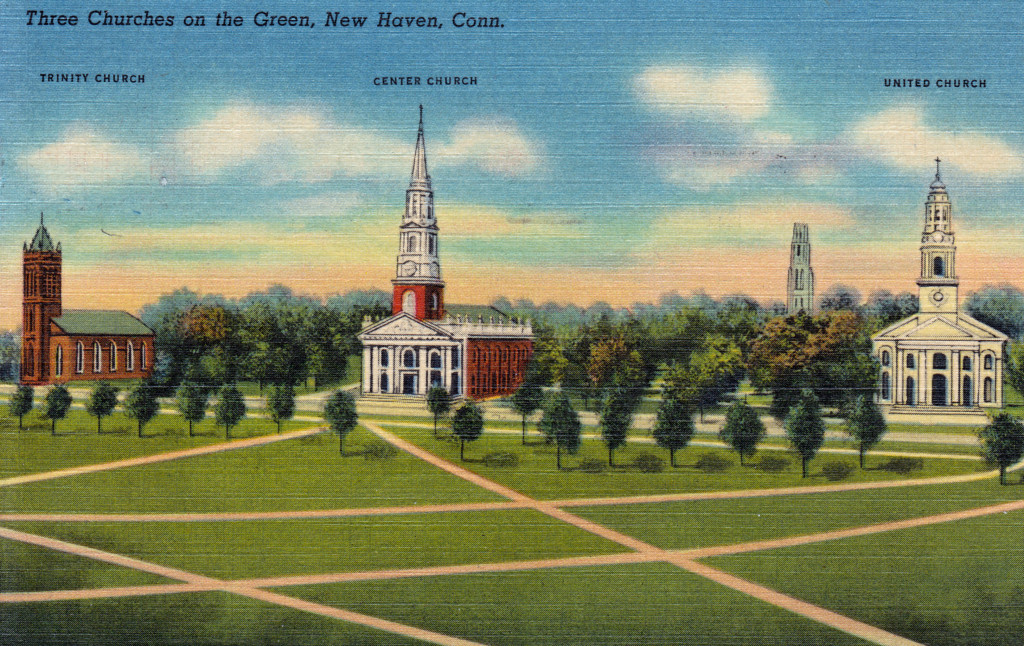
There was nothing but pure gold to be found in that neutral ground between Wooster Square and the Yale campus, the New Haven Green.  There Yale men who trolled for a pretty, dark-eyed girl from across the tracks might find a willing signorina from Olive Street for an interlude, a cross-cultural affair, a dip into foreign waters. 

The New Haven Green, historic burial place for the Davenports, the Potters, and the Longworths and gathering place for Revolutionary partisans whose militias were instrumental in the war against the British, was the modern day crossroads for the two communities.  Italians from Wooster Square came across the canal to shop at Malley's and see the latest Hollywood epics at the Palace and Strand, and crossed the Green in sight of Harkness Tower, the Old Campus, and Silliman College. 

Angie Lacava had never much thought about Yale, a world apart from the Italian neighborhood in which she had grown up. Depending on where you stood, you might see Harkness Tower and if the wind were right, hear the bells which rang every hour, but it would be passing, incidental, and irrelevant moment.  

The two sides of New Haven - the old Italian one with neighbors from Sorrento, Amalfi, and Naples, corner bakery shops that sold cannoli, bocconotti, and sfogliatelle, butchers, fish mongers, Jesuits, and mafiosi; and the Yale one, privileged, monied, well-to-do, legatees of old New England, the Massachusetts Bay Colony, Wall Street, presidents, and ship owners. 

Angie's father had always wanted her to marry a nice Italian boy, a doctor maybe, or a lawyer.  Italians were making it out of Wooster Square, having a go the the Anglo-Saxon world and at times making it big. Italians were already doing well in construction - demolition, cement, hauling, and roofing - and were big on the docks.  New Haven's port was small compared to anything in New York or New Jersey, but it captured the short-haul trade from Providence and Boston.  More than enough to make a living.

Most of the Italians on Wooster Square had worked their way up from day labor and were still half-educated guidos.  They made plenty but still were goombas with all the lawn ornaments, patio furniture, sconces, and Carrera marble of the working class.  Lacava wanted something more American for his daughter, and the Yale men across the green had it and then some.  They lived on Beacon Hill, had summer homes on Nantucket, wintered on St. Bart's, and skied on the slopes of Gstaad and Chamonix; and here they were not more than a mile away. 

Of course he underestimated the depth and width of the divide.  How could he possibly know what it was like to study Blake's Tyger, head off to Vail for Christmas, intern at J.P. Morgan, and marry similar wealth, privilege, history, and upper class drawing room sophistication?

However, he had a willing student in his daughter, Angie, who had always felt hemmed in, deceived, and misinformed.  America outside Wooster Square was not to be trusted.  It was venal, godless, greedy, and alcoholic; but on those occasions when Angie and her friends ventured past the Green and went to the movies or shopped at Malley's and rubbed shoulders with men from Yale, the warnings of her grandmother and maiden aunts seemed off the mark, inventions, gossip. 

The Yale men were handsome, confident, at ease with themselves, relaxed and able; and oh, what it would be like to be in love with one of them!

Once this scintilla of doubt crept in behind her protective, suspicious wall, it was preoccupying.  She could think of nothing else, and wondered what it would take to meet one of these gorgeous men.  Would she have to seduce them, trap them, entice them?  Or simply act their virginal, simple, pious selves and offer something deep and reassuring?

Anson Wright was one of these Yale men who was anxious to spread his wings, see what the palaver about hot Wooster Square girls was all about.  One foray across the tracks didn't mean a shotgun wedding, so if it happened, it happened. 

Watch your Ps and Qs', Angie's mother warned her when she got an inkling of her daughter's intentions. 'Those boys are no good' and went on to relate stories of girls of her generation who got hooked by the idea and snookered by one Yalie after another.  'You know what they're after', she said; and of course she was right.  No self-respecting Boston Brahmin or Fifth Avenue gentleman would want anything to do with them.  She knew because she cleaned up after them in their dining rooms, their residences, and their libraries. 

Angie, however, refused to be cloistered and corralled by a phalanx of fat duennas in black dresses.  Those were Old Country ways and this was America! and so she made her leisurely forays across the canal to park benches on the Green, hoping for a proper Mr. Right to notice her.  At the same time, despite her rebelliousness and hardened attitude towards Southern Italian prudery, she couldn't help but be influenced by it.  As she sat demurely on the bench, legs properly together, blouse buttoned to the top, and cardigan neatly arranged, she knew that there was more to Yale, the Green, and prospective wealthy husbands than met the eye. 

And so it was that they met on a park bench on the Green.   She reminded him of Anna Magnani who was playing in We, The Women at the Strand, of Anne Bancroft nee Anna Maria Luisa Italiano;  she with every stereotyped thing about him - his blond, straight hair, his fair coloring, his perfect teeth, his tall, easy grace.  They were who they were supposed to be, and that is as good a beginning of an affair as any. Men always are attracted to women who remind them of their mothers, etc. 

He was so charming, so unbelievably attractive, and so rich; and one thing led to another and soon he was inviting her to spend the night with him at the Taft.   He of course had been only trolling when he picked her up.  It didn’t take much with these Wooster Square girls unlike Vassar girls who checked family pedigree as carefully as a Hebrew manuscript in the Dead Sea scrolls.  They wanted to be wooed by someone of superior wealth, charm, and intelligence, but such a man was hard to find and harder to catch given the narrow, crowded milieu in which they lived.  These goomba twats only wanted someone, anyone with money. 

Angie politely declined his offer of a night at the Taft, but ended up giving it up in his Trumbull College dorm room anyway. “I can’t believe I’m really here”, she thought to herself as she kissed him and looked out the window at the College’s Gothic spires, manicured courtyard, and ancient window tracery.  Shortly after what had been a marvelous, romantic adventure for her but only a Townie interlude for him, he left her on the curb.

Image result for images trumbull college yale

It didn’t pay to get involved with one of them she told her girlfriends, sobbing, missing him, but angry at how she was so shamelessly treated.  “Never again”, she said. 

At about this time Yale had begun to come under increasing pressures from New Haven to invest more in the city - not only in infrastructure, but in human resources as well. It wasn't enough, City officials said, for Yale to hire the men and women who served the elite; it was time for them to recruit talented New Haven students for Yale's undergraduate body itself. The moment had come for New Haven's Italian-Americans to stop serving strawberries, and to eat them.

Yale agreed, but with a prejudice characteristic of the times, assumed that any Italian-American New Haven student would be only suitable for menial work, agreed to admit Richard Puzzi, Alderman Guido Marucci's highly recommended candidate who had been a football standout at New Haven High. At least this slab of hairy meat would make short work of the Princeton line, so fuck the grades. A memo went out to all Puzzi’s professors at the beginning of the year: "Pass this ape".

Image result for images yale logo

What the Yale recruiters didn't know - and in their rush to scrape up a bit of detritus from Olive Street - was that this hairy piece of meat was the son of a connected guy. Mario Puzzi had worked his way up in the Gianfredo family and was known in the neighborhood as someone who did generous favors but brooked no disrespect.  The only reason that his son Richard had been admitted to Yale was because of the pressure he put on Alderman Marucci.  It was win-win all the way around - a son at Yale, an Italian finally learning not serving, and even more respect for Mario and his family. 

So, despite her WASP yearnings, Angie returned to her roots and went to Mario for a favor.  Could his son, Richard, now enrolled at Yale, teach that philandering, deceitful prick Wright a lesson he would never forget? 

No one found out how or why the unfortunate Anson Wright got so badly beaten, enough to force him to take a year off from Yale, but rumor mills, ethnic prejudice, and preconception being what they are, it was assumed that his goomba chippy was behind it.

They never once suspected the new Yale Italian fullback who was indeed making mincemeat of the Harvard, Princeton, and Dartmouth lines, but that's the upside of prejudice.  The oaf got admitted to Yale, so that had to mean something. 

All this has changed in the Yale of today of course.  It no longer is the Old World, British colonial place of privilege and wealth that it once was.  It is now 'democratic' with all comers let in.  Diversity - not just the town-gown kind of decades before, but the real kind is the meme.  No need to cruise the New Haven Green anymore.  However with such libertinage something was missing.  No risk, no crossing the canal, no pursuit, and no consequence.  A dull affair; and Yale is now a dumbed down, safe place - a university like all others without cachet, admiration, or privilege. 

Alexander Hamilton And Fear Of The Majority - America Today, The Mob Rule Of The Unwashed

In the early days of the American republic, a vigorous debate went on, especially between Alexander Hamilton and Thomas Jefferson on the nature of democracy and the balance between the governing and the governed.  

Hamilton was suspicious of Jefferson’s populism – i.e. a deep faith in the wisdom of the people – and new that the American electorate could easily vote with unenlightened self-interest and venality no different from Jake Cade, the anarchist/populist of Henry VI, or the plebeians of the fickle mob of Coriolanus or Julius Caesar.  

In his Speech on the Constitutional Convention, Hamilton said:

All communities divide themselves into the few and the many. The first are the rich and well born; the other the mass of the people. The voice of the people has been said to be the voice of God; and however generally this maxim has been quoted and believed, it is not true in fact. The people are turbulent and changing; they seldom judge or determine right. Give therefore to the first class a distinct, permanent share in government. They will check the unsteadiness of the second.
Hamilton wrote further of his concerns in his Federalist Papers:
The republican principle demands, that the deliberate sense of the community should govern the conduct of those to whom they entrust the management of their affairs; but it does not require an unqualified complaisance to every sudden gust of passion, or every transient impulse which the people may receive from the arts of men, who flatter their prejudices to betray their interests...
When occasions present themselves in which the interests of the people are at variance with their inclinations, it is the duty of the persons whom they have appointed to be the guardians of those interests, to withstand the temporary delusion, in order to give them time and opportunity for more cool and sedate reflection. Instances might be cited, in which a conduct of this kind has saved the people from the very fatal consequences of their own mistakes, and has procured lasting monuments of their gratitude to the men, who had courage and magnanimity enough to serve them at the peril of their displeasure
The Framers agreed with Hamilton and created the Senate which would be the venue for such ‘cool and sedate reflection’; but Hamilton was far more of an aristocrat to trust an institution which was still an elected body.  His view of statesmanship reflected his views. As Historian Bruce Miroff noted:

Alexander Hamilton attempted to be, an aristocratic yet visionary statesman. Hamilton's statesman would resist and rise above popular prejudices and passions; occupying a commanding eminence, he would plan grand projects for the nation's future. His architectonic vision detailed instruments for efficient action: the energetic executive and the administrative state.

 Having shaped these powerful tools, he turned them to economic use, fashioning a carefully integrated set of policies that fostered the rise of manufacturing in the United States. While the aristocratic statesman did not expect the public to understand his vision, he did expect it to respond to the prosperity and power that his efforts produced. As the nation rose to greatness, so, ultimately, would his fame. 

 Image result for alexander hamilton

It isn't bad enough that American democracy has devolved from the reasonable governance envisioned by the Founding Fathers - sane, reflective, objective, universally patriotic men providing wise guidance to the electorate - into a free-for-all, a chaotic, inchoate brouhaha of petty demands of insular, selfish motivation. The country has fragmented into artificial, competing interest groups of race, gender, and ethnicity. 

Not only do the unwashed rule, they rule in caviling, self-centered cabals.  The House of Representatives is a side show of bearded ladies, babies with two heads, dwarves, and grotesque giants.  The Senate, the compromise between Hamilton and Jefferson, designed to be a buffer between the caterwauling of the masses and the higher powers of national leadership, had descended into the same mindless anarchy. 

The very idea of federalism, the core principle of the Constitution, has devolved into the worst kind of narrow political demands. If the state legislatures aren't bad enough, catcalling, smearing, and food fighting over issues supposedly good for the citizens under their protection, municipalities have sunk to an even lower, unconscionably ignorant morass of vaporous politicians. 


Avowed Socialists are mayors of New York and Washington.  Portland and Seattle have become ungovernable Third World shitholes of crime, addiction, incivility, and political anarchy. Hundreds of people are shot and killed every weekend in Chicago where the mayor claims racism, police brutality, and federal indifference for the violence.  Baltimore, St. Louis, and Memphis ranking near the top of the world's most violent cities are havens for illegal immigrants, safe places for gangs, drug crewes, and wanton criminals.

It is hard to imagine how the country after World War II and its uncompromising defeat of Hitler and Hirohito and recognized as the beacon of sanity, the nation of opportunity, justice and fairness, has so rapidly descended into such political dissension, division, and unholy chaos. 
 
It is even harder to imagine how so many voters think that such division into identity groups who claim legitimacy and justice only by sex, race, and ethnicity is a good thing; voters who have chosen separatism and superficial judgment over  central, universal, moral ethos. 

Jefferson made it quite clear when he explained 'the pursuit of happiness'. Americans were to pursue individual enterprise and benefit from their labors but not at the expense of others.  Individualism and community were two branches of the same tree.  He envisaged a country whose citizens acted with individual spirt, desire, and determination but were mindful of the larger commonwealth in which they acted.  All Americans were to abide the same moral, Christian code. 


Other powerful nations of the world, many America's adversaries have understood the absolute necessity of a central ethos around which all enterprise - personal, regional, and national - revolves.  China has refused to tolerate ethnic separatism, and seen such parochial demands antithetical to the nation.  The Uighurs, the Tibetans, and the Taiwanese are insurrectionists, antithetical to the smooth running or the state. a

Autocracy? Hardly. Based on a Confucian ethos, a long history of Chinese world influence, and thousands of years of dynasty and high culture, China has raised hundreds of millions out of poverty, engineered wealth, prosperity, and world leadership. 

Russia, renascent after decades of ruinous Communism has harkened back to its imperial past and brooked no dissension from separatist ethnic groups in the Caucasus. A united, indivisible Russia must never be challenged. 

Turkish President Erdogan has the same intimations of empire and is determined to return the country to its Ottoman, fundamental Islamic roots.  Iran, however insidious and adversely militant as the theocratic regime might be, it has the same unifying, absolute commitment to its Persian and Islamic past. 


Europe is in the process of electing ultra-conservative governments in France, Germany, the UK, and the Netherlands.  Italy, Denmark, Sweden, and Finland have already vowed to shut the door to unwanted African and Middle Eastern immigrants, to close mosques and to deport any imam or mullah who preaches separatism and anti-European, Christian values. 

'I am Giorgia', shouts Giorgia Meloni, President of Italy. 'I am a woman, I am a mother, I am a Christian, I am European, and I am Italian', the litany of new wave Europeanism sweeping the continent.  Enough 'diversity' and calls for 'the other'.  It is time to recognize Europe's greatness and return it to his legendary leadership. 


Only the United States clings to its febrile, fantastical, baldly idealistic view of society.  Not only does the American Left lionize the mob, but in its call for Diversity Equity Inclusion, encourages its basest, least intelligent, bottom-feeding instincts. 

Hamilton is turning over in his grave and Jefferson stirring.  How could this new country, born of the Enlightenment, guided by such profound and universal moral and ethical values have fallen so far into anarchy and international disrepute?

It is probably too late to reverse the course, to re-establish the moral order, patriotism, and universal civility envisaged by the Founding Fathers; to late to center the nation, to end deliberately engineered divisiveness and hostility, to return to civilized values and culture; and so be it.  You reap what you sow. 

Historical revisionism - the rewriting of history, the expunging of inconvenient truths, and the blatant ignorance of the past can only accelerate America's descent to the bottom.  The unwashed majority, already ignorant, marginally educated, decidedly fundamentalist, and unremittingly parochial will continue to grow at the country's peril. China and Russia are watching from the wings, patiently awaiting its downfall.