"Whenever I go into a restaurant, I order both a chicken and an egg to see which comes first"

Sunday, December 20, 2020

There’s A Monster In My Closet And Other Imaginary Delights

Petey Ballard was three years old and loved to search the house for imaginary monsters.  He and his father opened every closet, climbed the rickety stairs to the attic, poked under boilers, oil tanks, and water heaters in the basement, and snuck up on washing machines, dryers and dishwashers.  Petey was not afraid of monsters.  “I know they’re not real”, he said, but in a way they were, otherwise he wouldn’t have enjoyed the search.  A child’s world is one of could be, probably isn’t,and  certainly might be, a first look into the adult subjunctive, conditional world.  Knowing that weird creatures would not be under the bed but in some way could be, is the indefinable middle kingdom of childhood and the first step to adulthood.

Image result for Images Book Cover Where the Wild Things Are

Those who first heard the stories of the Sumerian mythical hero Gilgamesh in 2700 BC or even Sir Gawain and the Green Knight in the 14th century never entirely believed the epic, fantastical tales of dragons and evil spirits retold by griots and storytellers, but never dismissed the possibility either.  The story of Christianity is one of magic, myth, and fabulism. Hinduism would be an esoteric, remote religion without the Ramayana and the marvelous exploits of the gods. The Roman gods of thunder, the sea, and the underworld come and go, mate and procreate with human beings, are at once accessible and terrible.

 Image result for images sir gawain and the green knight

Milton’s Paradise Lost is Christianity’s heroic myth, its Ramayana, its Gilgamesh and Sir Gawain.  It is an epic story of the titanic battle between good an evil, between the forces of the canny, brilliant Satan, and the Son of God sent down to deal with the apostate angel, the one cast out of Heaven and determined to regain his rightful place and dominance over all.

Image result for Images Paradise Lost

In today’s modern, logical, scientific, and objective world, myths are vetted and culled – some still believed and others relegated – but those that remain are persistent and unchanging.  There was indeed a man who walked on water, rose from the dead, worked miracles, is invoked at holy masses and present on their altars.  Millions believe that this Christ will soon return to Earth, again destroy it in a vengeful purge of evil and wantonness and offer salvation to a pure, idyllic heaven to those who have been faithful.

For millions of others the myth of resurrection and salvation by a supreme being is not enough. The myth of aliens of supreme intelligence who will conquer, destroy, and repopulate the Earth is as persistent as the New Testament.

We have never been weaned from the existential fantasy of childhood. Even for supposed non-believers, Jesus just possibly could be real, that an eternal life of beauty and peace could await them.  No matter how hard-bitten, cynical, and dismissive they may be, adults never lose their fantastical beliefs. To be honest, what would the world be without the magical, mystical beliefs of religion and myth?  Nasty, brutish, and short, wrote Hobbes, without respite; and for most at best a four score and ten year slog if that.

Image result for images thomas hobbes

We do our best to mitigate the boredom, the yoke of work and marriage , and the seemingly interminable string of perfunctory responsibilities. There are summer vacations, Christmas presents, graduations, and tributes of our own making. Hobbes never said that life was all nasty and brutish, and even he must have had some fun. 

Yet these outings are just diversions, happy faces with nothing to do with existential myth.  Jesus is always there in the wings – on the stations of the cross, in hymns, readings, and devotions.  Myth, particularly one which has persisted for so long and has become embedded and institutionalized in a human ethos, cannot be dismissed or marginalized.  One may not believe everything – liberal theologians are willing to entertain the thought of metaphor and allegory – but the core belief is unshakable.  In some form or other Jesus, God, are always right around the corner.

Image result for images jesus on cross

Which brings us back to Petey Ballard and the imaginary monsters in the closet.  The other day he and his father played imaginary foosball.  Petey tired of the movable men on steel rods, and the soccer ball.  It was more fun to play with an imaginary ball and and play finger goal, or to wonder how the moon could somehow shine over the garage and over the trees in the far woods, and on the foosball field.  Childhood was still a place of multiple possibilities where the moon popped up in unexpected places, where imaginary goals were scored, and where scary things came and went.

We don’t grow out of childhood, only mature where necessary. Father Brophy warned that the Devil was around the corner, hiding in comfortable places.  There were good angels, guardian angels, loving and protective angels about.  The world was not as one might think only with kitchens and light stands and Cadillacs.  “Open your souls”, he said, “not your eyes which will never be of help to those blind to Jesus”. 

Image result for images the devil dore

It has often been said that the only reason to have children in an affluent age is to relive lost innocence.  True enough, but as much it is to see clearly what we have tried to ignore.  We cannot admit our belief in the supernatural, the mythical, or the unimaginable without at least some hesitancy.  We have been forced to contextualize our mythical fantasies, and not go whole hog.

Petey’s father encouraged him and went with him on his monster hunt every morning.  He was reluctant to give up the myth and the lost innocence.  He was complicit, a willing partner in fantasy, a child himself.

It is too harsh and unfair to say that human beings are a credulous lot.  We were born with myths, fantasies, and monsters in our heads – part of our genetic wiring that helps us in our Hobbesian journey.

Wednesday, December 16, 2020

The Other - The Fascinating, Unsettling World Of Freaks, Misfits, And Outliers

The characters of Sherwood Anderson’s Winesburg, Ohio are emotionally wounded and troubled by shame or regret - a former schoolteacher once accused of intimacy with his students; a pastor who hides in the darkness to watch his neighbor undress; a clerk who, after being jilted by her lover, runs naked through the streets.
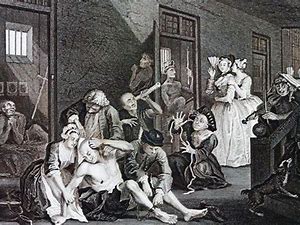
Image result for images bedlam

People have affairs; they hide histories of theft and perhaps murder; they think of killing their spouses, and they bury their savings so their husbands won't get at them; they worry they can't run away from their pasts or that they'll never escape their provincial lives. There is nothing predictable about Anderson’s characters. His sense of what he calls the ‘grotesque’ pervades every story. By grotesque he did not mean anything deformed or twisted, but just so unique, so secret, so hidden that if and when it was expressed, it would resemble nothing normal, nothing familiar to the people around. 

Anderson writes about these characters with compassion and understanding. They are only ‘grotesque’ because of their own, private, secret ‘truths’ and suffer because they are unable to keep them theirs. There is an underlying desire to make these truths known and have them realized and accepted by others. They do not realize how strange and distorted their visions are, but Anderson never portrays them as truly grotesque, freaks, and lunatics.

Image result for images sherwood anderson

Winesburg opens with ‘The Book of the Grotesque’. In the beginning, writes Anderson, when the world was young, there were many thoughts but no such thing as truth. “Man made the truths himself, and each truth was a composite of a great many vague thoughts”. All these truths were beautiful, and then people came and co-opted and compromised these truths. “It was the truths which made the people ‘grotesques’…The moment that anyone person took a truth to himself and tried to live his life by it, he became a grotesque and the truth he embraced became a falsehood.

The stories of Winesburg are remarkably similar to those of Flannery O’Connor. Both writers have captured a sense of the marginally sane – men and women not only confined within the limits of restrictive social norms, but confined within their own peculiar humanity, one which has little to do with the normal course of life. Their characters have impossible expectations, distorted views of themselves and those around them, and act in an almost unrecognizable world of imagination and almost perverse fantasy. O’Connor’s story A Stroke of Good Fortune begins this way:

Ruby came in the front door of the apartment building and lowered the paper sack with the four cans of number three beans in it onto the hall table. She was too tired to take her arms from around it or to straighten up and she hung there collapsed from the hips, her head balanced like a big florid vegetable at the top of the sack.

She gazed with stony un-recognition at the face that confronted her in the dark yellow-spotted mirror over the table. Against her right cheek was a gritty collard leaf that had been stuck there half the way home. She gave it a vicious swipe with her arm and straightened up, muttering, “Collards, collards,” in a voice of sultry subdued wrath. Standing up straight, she was a short woman, shaped nearly like a funeral urn. She had mulberry-colored hair stacked in sausage rolls around her head but some of these had come loose with the heat and the long walk from the grocery store and pointed frantically in various directions. “Collard greens!” she said, spitting the word from her mouth this time as if it were a poisonous seed.

Ruby, like many of Anderson’s characters, is an emotional misfit with little sense of adjustment to the world around them. They have a vague notion of peculiarity, understand somehow that theirs is neither the vision nor the world of others, but they make do, manage, and remain. There is nothing sophisticated, worldly, or demanding of them. Bad things happen to them, to be expected, to be worked round, but which will never change.

Image result for images flannery o'connor

Thirty-four wasn’t old, wasn’t any age at all. She remembered her mother at thirty-four—she had looked like a puckered-up old yellow apple, sour, she had always looked sour, she had always looked like she wasn’t satisfied with anything. She compared herself at thirty-four with her mother at that age. Her mother’s hair had been gray—hers wouldn’t be gray now even if she hadn’t touched it up. All those children were what did her mother in—eight of them: two born dead, one died the first year, one crushed under a mowing machine. Her mother had got deader with every one of them. And all of for what? Because she hadn’t known any better. Pure ignorance. The purest of downright ignorance!

Ruby is concerned with life, death, and meaning without any rational coherence; instead in a scattered, part mystical, part religious, part circus way. She consults a medium, ‘a stout woman with green eyes that moved in their sockets as if they had been oiled’, she listens to friends who are just as fragmented and unhinged in their thinking as she is.

“Noooo,” she said and leaned her round red face between the two nearest poles. She looked down into the stairwell and gave a long hollow wail that widened and echoed as it went down. The stair cavern was dark green and mole-colored and the wail sounded at the very bottom like a voice answering her. She gasped and shut her eyes.

No. No. It couldn’t be any baby. She was not going to have something waiting in her to make her deader, she was not. ..She shuddered and held her hand tightly over her mouth. She felt her face drawn puckered: two born dead one died the first year and one run under like a dried yellow apple no she was only thirty-four years old, she was old. Madam Zoleeda said it would end in no drying up. Madam Zoleeda said oh but it will end in a stroke of good fortune! Moving. She had said it would end in a stroke of good moving…

She sat on the step, clutching the banister spoke while the breath came back into her a thimbleful at a time and the stairs stopped seesawing. She opened her eyes and gazed down into the dark hold, down to the very bottom where she had started up so long ago. “Good Fortune,” she said in a hollow voice that echoed along all the levels of the cavern, “Baby.” “Good Fortune, Baby,” the three echoes leered. Then she recognized the feeling again, a little roll. It was as if it were not in her stomach. It was as if it were out nowhere in nothing, out nowhere, resting and waiting, with plenty of time

In Anderson’s story Paper Pills, the main character, ‘the tall woman’ has similar fantasies, less dreams than twisted notions. She is being courted by two young men, one who ‘talked of virginity’ and the other, ‘a black haired boy with big ears’ who said nothing at all but wanted her.

Beneath his talk of virginity, she began to think there was a lust greater than all others. At times it seemed to her that as he talked he was holding her body in his hands. She imagined him turning it slowly about in the white hands and staring at it. At night she dreamed that he had bitten into her body and that his jaws were dripping. She had the dream three times, then she became in the family way to the one who said nothing at all but who in the moment of his passion actually did bite her should so that for days the marks of his teeth showed…

In the end she becomes involved with her doctor, a man as unsettled and strange as he, a final fitting affair before she dies

The condition that brought her to him passed in an illness, but she was like one who has discovered the sweetness of twisted apples, she could not get her mind fixed again around the round perfect fruit that is eaten in city apartments. In the fall…she married Dr Reefy, and in the following spring she died. During the winter he read to her all the odds and ends of thoughts he had scribbled on bits of paper. After he had read them he laughed and stuffed them away in his pockets to become round, hard balls.

There are strange, unsettling people everywhere.  A young boy whose father had taken him to a Yankee World Series game, was headed down to Grand Central on the subway. As the train made its way to Manhattan a man with no shirt, sequined tights and a multi-colored beanie came through the car. He held a Bible and quoted from it.  He had a crazed, wild look as he preached about Jesus, salvation, damnation, hellfire, and eternity; the boy’s first look at the demented.

Rectangle Lady was a woman all dressed in black who marched in straight lines up and down the block between 114th and 115th Street on the Upper West Side.   She did precise military turns at the end of the block, pivoted, and marched back up the way she came but on the curb side.  She had a vacant, long-distance stare into a dark universe.

A well-dressed man who took the Red Line to downtown Washington every day at the same hour.  He talked to himself the whole time.  He doesn’t mutter or mumble, but converses.  Who was the unknown communicant who rode the train with this commuter every day? In what fantasy universe or unspeakable hell of his mind did he reside?

Or the man who boarded a train and no matter what the weather, dressed for an Arctic winter. He wore four layers of clothing – a parka on top of a car coat on top of gabardine on top of sweaters and thermal insulation. In his mind an Ice Age must have come.

Patrick McGrath writes about the insane without the compassion of Anderson or O’Connor but with a psychiatrist’s vision of the demented mind.  Spider is the story of a disturbed, psychotic boy who kills his mother and is committed to a mental institution where he spends thirty years.  Although he is released, he is no less psychotic than when he entered.  He is a timid, frightened but still violent man who lives in a distorted world of twisted, demented illusion.  He sees women who are his mother, beings in the attic, and feels the sinister, unholy power of the gas works.

Image result for images ralph fiennes movie spider

Craziness, dementia, and psychosis are not unique but generalized – alternate universes alien and troubling.  The biographical film about the Nobel mathematician John Nash explores his obsession with the imaginary figures who pursue him.  Those visions and his logical brilliance lead him to crazed fugues of mathematical formulations to explain a dissolving, frightening world.  

An old woman with severe dementia lived in a nursing home in Connecticut, and despite her final mental detachment from family and friends, her alternate world was far more fascinating than the bounded, logical one she left.  The Pope came to visit, male striptease shows played in the auditorium, she was a cheated upon wife in an afternoon soap, a murderer, a jewel thief, a channel swimmer.  Yet, whatever Leona Thompson was had not left.  She just laughed at people who were not there, who did impossible things, but who were as real as the brick and mortar of Fairhaven Home. It was difficult for her sisters and children to see her this way, and only more distant relatives could enjoy Auntie Leona who hadn’t changed a whit, and was still the same irreverent, ironic woman she was when she ruled her West Haven roost.

We are all Auntie Leona, Spider, Ruby, and ‘the tall woman’.  Our dementia is on hold, our psychoses in the closet. We are on some verge.  The freaks around us are unsettling reminders of not only where we might be but for the grace of God, but where we actually are.  It is not hard to see the world as Picasso, Matisse, Duchamp, or Van Gogh did.  We have never outgrown monsters under the bed or strange shadows in the trees. It doesn’t take much to unhinge us; and perhaps the most aware and perceptive of us come to believe they are still there,

Thursday, December 10, 2020

Are We Alone? Aliens In Our Midst, And What To Do About Them

For many people the question, ‘Are we alone?’ is moot.  Of course we aren’t.  This has nothing to do with God or Jesus, of course, who have always been with us, never leaving us alone. It has to do with the existence of life on other planets.  Not just life, but a highly evolved species which has overcome the speed of light and every other limiting principle of human science.  Moreover, these beings have already visited Earth on many occasions, some rather frequent.  The story of benign abductions are common, and the stories of returnees are filled with hope, joy, and remembrance.  If only they had been allowed to stay, they say, and not returned to this benighted planet for more penance and ineptitude.

The American military and intelligence establishments have known about alien visitations for decades, but have kept the truth from ordinary Americans because of security reasons.  Study goes on in top secret laboratories under the Utah desert to decipher the codes, inscriptions, and markings on spaceships that accidentally ran aground; and to understand the highly sophisticated technology the aliens used to get here from such a distant source - anti-gravity, molecular dispersal, cosmic fragmentation, minus E=MC2, , polar reversal, and much more. If even a hint of these advanced but still unknown technologies were to leak out, our enemies would be sure to use them against us.

Image result for images roswell

The American military establishment is salivating at the thought of death rays and the realization of all the destructive power imagined by science fiction writers for decades.  Compared to these annihilating forces, the hydrogen bomb would be nothing – fireworks on the Fourth of July.   Tele-transportation, here to there without travelling; a state of incorporeal being in which one can be in two or more places at once; mind-reading, time travel, universal upsy-daisy, mind-boggling alterations of space-time, no death, eternal life, absolute victory and universal conquest are all on American top secret scientists’ minds.  Of course things like this – even speculative science – should never get above ground and should stay, until weaponized, 1000 ft. below the Moab desert.

Currently Christian theologians are debating the existence and nature of sin in the universe, and whether aliens can or should be saved.  The answer for such questions has become all the more urgent since a scientist at SETI has estimated that given the super-powerful radio telescopes being developed (China has just inaugurated the world’s largest), it might be only twenty years before contact is made.

Image result for images seti radio telescopes

There are many sides to the argument.  Creationist Ken Ham, for example, observed that:

Earth was specially created by God and the sin committed on Earth would affect the rest of creation. The Bible makes it clear that Adam's sin affected the whole universe. This means that any aliens would also be affected by Adam's sin, but because they are not Adam's descendants, they can't have salvation. Christ's work of salvation can only apply to humans as the descendants of Adam. 
Other Christians disagree, noting that although God’s dominion extends to all beings in the universe, if  an extraterrestrial lacks a spiritual aspect, an eternal soul to save, then it does not need saving.
Christian Weidemann, a German Protestant theologian takes a somewhat different tack suggesting that  perhaps extraterrestrials aren't sinners, like humans, and therefore aren't in need of saving.  But given the fact that all known intelligent beings (human beings) are sinners, it is likely that all other intelligent life in the universe would also be.  
Assuming that the latter argument is true – all intelligent life must sin – than God may have incarnated himself multiple times according to the particular configurations of sin and intelligence on other planets.  Clara Moskowitz, a journalist writing about space and religion reports on another of Weidemann’s speculations:
Another possibility is that God incarnated multiple times, sending a version of himself down to save each inhabited planet separately.
However, based on the best guesses of how many civilizations we might expect to exist in the universe, and how long planets and civilizations are expected to survive, God's incarnations would have had to be in about 250 places simultaneously at any given time, assuming each incarnation took about 30 years, Weidemann calculated.
Nathan O’Halloran, a Catholic theologian, suggests that Jesus’ sacrifice on the cross here on Earth was the moment of salvation for all intelligent life in the universe:
So why can his death not include other alien races too…?  Maybe what Jesus assumed that is important is not the human form, but the rational free spiritual form, and this is what he redeemed, thereby including all personal races, alien or human.
In other words Jesus, the cross, and his resurrection are at the heart of all salvation.  Thus not only for all humans but all aliens as well:

All things were created…through Jesus and for Jesus… He is before all things, he holds together all things. In other words, he stands as the head of the cosmos, as its beginning and end, its past and future…  Nor can there be other Jesuses, since Paul is clear that it was “by the blood of his cross,” that peace was made.  It is unlikely that if Jesus was incarnated on another planet he would be killed there by a cross as well…  He would be killed in some other way.  But Paul is clear that by the blood of his cross, this Jesus saved all things, whether in heaven or on earth.

Image result for images christian salvation

While this debate may seem silly to most secular observers concerned more with the practical benefits that might accrue from contact with a superior intelligence or with the dire consequences of a hostile, predatory alien race than any question of salvation, it is far from trifling to Christians who know that their very Earth-centered story of Jesus may be thrown into question or even dismissed entirely.

A confirmed presence of a superior intelligence would explain a lot of things.  Some have even suggested that human beings are simply alien mind games, fantasies, juvenile distractions – a theory which would explain the persistent illogic of human endeavor. If we were really smart and very intelligent, we would never do stupid things; but if we are only some characters in a hyper-Nintendo video mind game played in a distant galaxy, then our aberrations are explainable.  We can relax.  It isn’t our fault at all.

What if the alien race that is among us is benign? and only waiting for the right opportunity to come out and show us the way? That theory bumps up against some conservative Christian thinking – God is the only one who makes or breaks humanity and pain, penury, misery, and liability are part of His plan.  Good and evil must always exist on the same plane, otherwise salvation would be simply a fairy tale.  Adam and Eve were expelled from Paradise for a reason and as a lesson.  The idea of an alien with the power to reform the world and make it a uniformly benign place is anathema and totally unacceptable.

Political progressives completely deny this so-called Theory of Alien Benignity, for it erases their raison d’etre.  Progressives believe that they can reverse the pernicious trends of history, reform this imperfect world, and create a Paradise on earth, a Utopia, a final resting place; and they can do it without God or the help of alien forces, no matter how well-meaning or –intentioned.

The American corporate interests are enthusiastic, but still circumspect.  They assume that an alien intelligence would be able to harness energy in ways that we can only imagine, and tapping into that technology would be a boom for our energy sector.  Of course, these same aliens may be perusing earth for resources it needs for its own civilization, but how important can copper, cobalt, or iron be to them?  No, alien science can be applied, adapted, and marketed.

The idea of a purely evil alien force that has to be destroyed is the most popular conception of space invaders.  They want nothing but are possessed by some universal destructive force – an appetite for death and mayhem.  This appeals to most people because it is an extension of our own human nature, just serialized in pop form.  In fact we would welcome such an existential battle of our good vs their evil.

Image result for images comic book cover alien invasions

And so it goes.  it is hard to imagine that we human beings are the only intelligent life in the universe; and so it is very human to create aliens in our image.  More than likely a space intelligence will be more akin to the idea of Arthur C. Clarke – a universal presence rather than a physical one.  Or an intelligence so advanced that it passes over, under and through us without even noticing our presence.  It is not that we are insignificant, just that their physics and cosmology is set up according to unimaginably foreign concepts.

Will aliens finally come out of the closet?  Religious fundamentalists believe that Armageddon will come in our lifetimes, so why not aliens?